
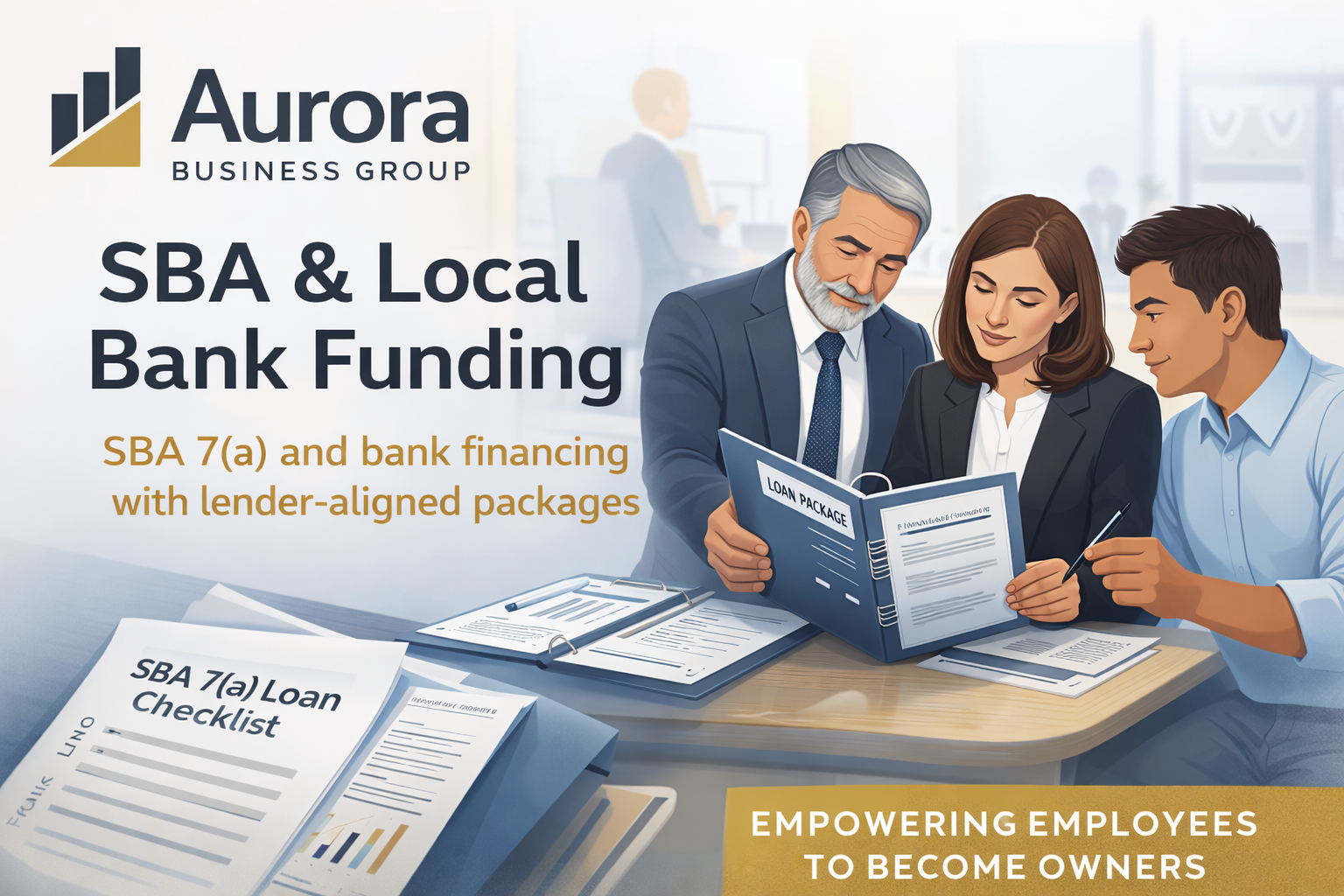
Building an Ownership Transition That Is Financeable, Defensible, and Built to Last

At Aurora Business Group, we focus on two pillars that determine whether an ownership transition closes smoothly—and survives after closing:

  1. Financing structure that works for lenders and cash flow
  2. Legal structure that safeguards the company and the parties involved

This page outlines the practical guidelines we follow for SBA-funded deals, internal management buyouts (MBOs), and minority equity programs.

Financing Guidelines

A financeable transaction has three characteristics:

  • Clear source and use of funds (purchase price, fees, working capital needs)
  • Supportable debt service based on proven historical cash flow
  • Post-closing operational stability (no cash-starvation, no leadership gaps)

Guideline: Structure payments and obligations so the business can operate strongly after the transaction—not just close it.

SBA lenders commonly focus on: repayment capacity, borrower qualifications, collateral, and documentation consistency.

Core financing principles

  • Cash flow first: Demonstrate conservative ability to service debt.
  • Clean documentation: Valuation, purchase agreement, and financial statements must align.
  • Prudent working capital: Avoid structures that strip liquidity at closing.
  • Transparent seller involvement: Clearly define any seller note, standby expectations, and ongoing roles.

What we prepare (typical lender package inputs)

  • Historical financials, interim statements, and normalization notes
  • Projections with assumptions that tie to operational reality
  • Valuation summary and purchase price rationale
  • Debt schedule and repayment plan
  • Management capability narrative and organizational chart

When financing comes from a mix of bank debt, seller financing, and earn-outs, the risk is usually over-leverage and unclear incentives.

Guidelines

  • Keep seller note terms aligned with cash-flow capacity
  • Use milestones for earn-outs that are measurable and auditable
  • Avoid “balloon risk” that forces refinancing under pressure
  • Align control with responsibility (do not create decision paralysis)

Minority equity is often used to build ownership culture while the founder retains control.

Guidelines

  • Define liquidity and repurchase mechanics before issuing shares
  • Use clear valuation methodology and periodic refresh rules
  • Maintain lender comfort (minority structures should not create hidden liabilities)
  • Clarify distributions: when allowed, when restricted, and who approves

Legal Guidelines

Legal documents must do more than “memorialize” a deal. They must prevent predictable disputes.

Guideline: Every agreement should reduce ambiguity around economics, authority, and exit paths.

Transaction clarity

  • Purchase structure (stock vs. asset) clearly defined
  • Accurate representations, warranties, and disclosure schedules
  • Indemnities aligned with realistic risk (not wishful thinking)

Governance and authority

  • Decision rights clearly assigned (who controls what, when)
  • Board composition and voting thresholds defined
  • Reserved powers for major decisions (debt, dividends, hiring/firing CEO, capex)

Exit and conflict protections

  • Buy-sell provisions (trigger events, timing, pricing, funding)
  • Repurchase rights for termination or resignation
  • Non-solicitation/confidentiality to protect the enterprise

Dispute resolution steps to avoid expensive litigation

For SBA or bank-financed deals, legal documentation must be consistent with lender requirements.

Guidelines

  • Ensure ownership/control provisions align with lender expectations
  • Document seller financing terms cleanly (including any standby requirements)
  • Avoid side agreements that contradict the loan file
  • Keep compensation, distributions, and related-party arrangements transparent

How Aurora Business Group Helps

We coordinate financing and legal inputs so the transaction is:

  • Financeable (underwriting-ready)
  • Defensible (legally sound)
  • Operationally safe (cash-flow stable after closing)

We work alongside your CPA, attorney, and lender—aligning everyone to one coherent structure.

If you are planning an SBA-funded MBO, an internal buyout, or a minority equity plan, we can help you:

  • Stress-test financing capacity and working-capital needs
  • Align valuation, purchase terms, and lender expectations
  • Build legal safeguards that prevent disputes and protect the company

Let’s structure your transition to close cleanly—and endure.