
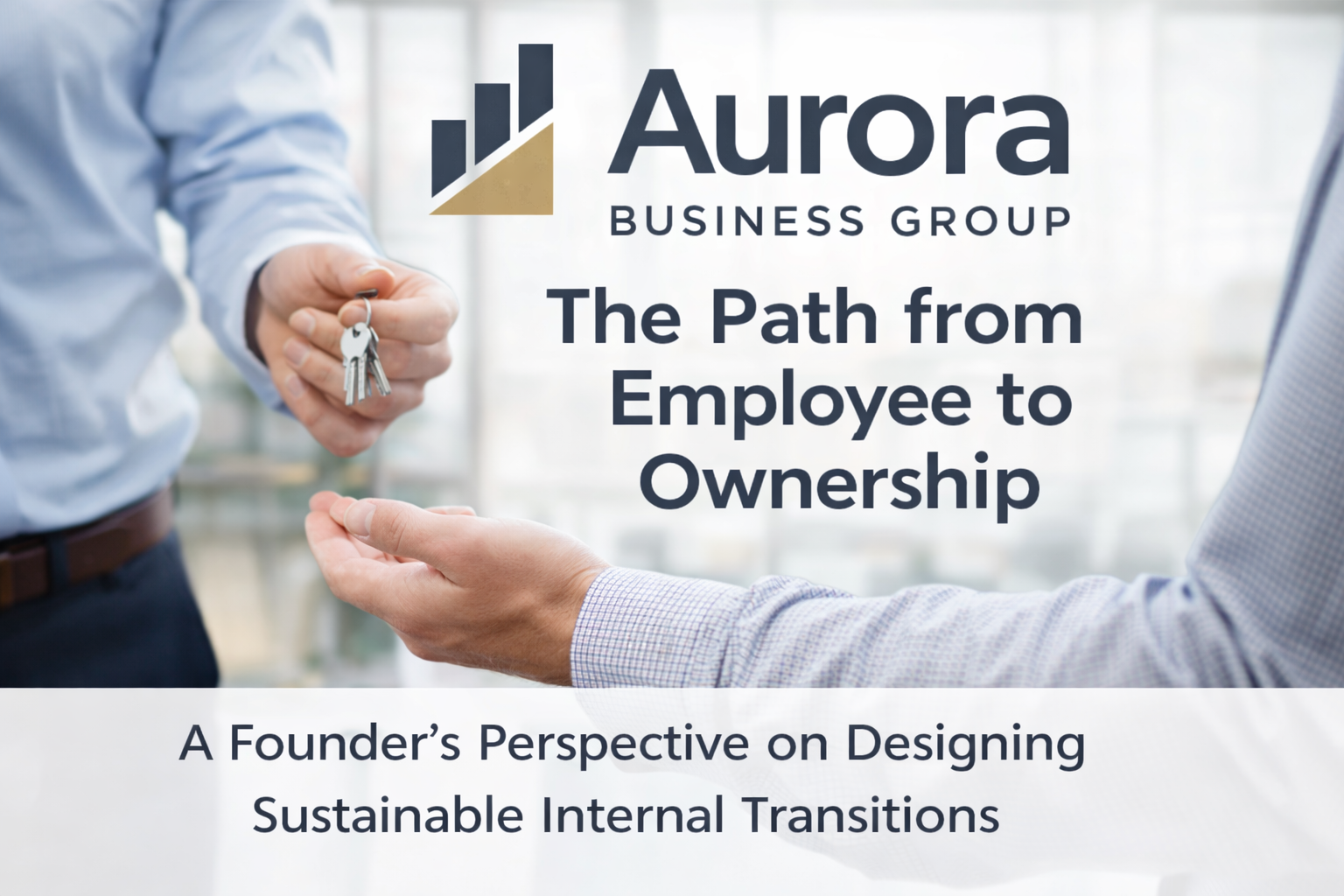
I have spent decades building businesses—starting them, growing them, rescuing them, and eventually preparing them to live beyond me. Along the way, I learned a difficult truth:
Ownership is not granted. It is earned—and earning it takes time, structure, and humility.
At Aurora Business Group (ABG), the work I do today is shaped by lessons learned the hard way. This is not theory. It is experience.
When I First Considered Internal Ownership
Like many founders, I once believed that equity would naturally motivate my most loyal employees. They had been with me through hard years. They cared. They deserved a seat at the table.
What I underestimated was this:
care is not the same as readiness.
I learned quickly that being exceptional at execution does not automatically translate into thinking like an owner.
The Moment I Realized Ownership Is a Different Role
Employees focus on solving problems. Owners must decide which problems are worth solving—and at what cost.
The turning point for me came when I watched capable managers make decisions that were logical in isolation but harmful in aggregate. Not because they were careless—but because they had never been taught to see the whole system.
That was my responsibility, not theirs.
Ownership requires:
- Understanding cash flow, not just revenue
- Accepting trade-offs, not just wins
- Carrying consequences beyond one’s role
Until those skills are learned, equity creates confusion—not alignment.
Why I Stopped “Handing Over” Authority
Early on, I made the mistake many founders make:
I transferred authority too quickly, hoping responsibility would follow.
It rarely does.
I learned that authority must be earned in layers:
- Responsibility without authority
- Shared authority with guidance
- Independent authority with full accountability
Only after walking this path do people begin to think like stewards instead of operators.
The Emotional Shift No One Warns You About
The hardest part—for both me and my successors—was emotional.
For employees, ownership challenge’s identity:
- You can no longer be right at all costs
- You must balance loyalty with sustainability
- You carry decisions home with you
For founders, it is just as difficult:
- Letting go without disengaging
- Influencing without controlling
- Trusting a process instead of instincts
This transition does not happen on a balance sheet. It happens internally.
Why I Built a Structured Path Instead of a One-Time Event
Eventually, I stopped thinking about ownership as a transaction and started treating it as a journey.
A journey with:
- Clear stages
- Financial education
- Governance boundaries
- Coaching on both sides
When ownership is phased and intentional, it strengthens the business. When it is rushed, it fractures trust.
What This Means Today
This is why I founded Aurora Business Group.
Not to promote ownership transfers—but to prepare people for them.
I have seen what happens when:
- Employees become owners before they are ready
- Founders step back before systems are in place
- Lenders fund transitions without structural discipline
And I have seen what happens when the path is designed thoughtfully.
Reflection
The path from employee to ownership is not about equity percentages or closing dates.
It is about:
- Maturity
- Stewardship
- Responsibility
- Time
When ownership is earned with clarity and supported with structure, it becomes one of the most powerful continuity tools a business can have.
That is not just a belief.
It is a lesson written into my own journey—and the reason I now help others design theirs.
Design the Transition Before It Designs You
If you are considering internal ownership, succession, or stepping back from day-to-day control, the most important work happens before equity ever changes hands.
Good intentions are not enough.
Experience alone is not preparation.
And timing without structure creates risk.
Aurora Business Group works with founders who want to:
- Protect the mission and standards they spent decades building
- Prepare employees to think and act like owners—before ownership
- Transition from control to influence without losing clarity or confidence
- Preserve enterprise value while creating continuity
👉 Schedule a Founder Readiness Conversation
A confidential, strategic discussion focused on your goals, your people, and the structures required to make internal ownership work—on your terms.
Because the strongest transitions are not rushed.
They are designed.